- Sports Med U Newsletter
- Posts
- The Role of Ice in Injury Recovery & Exercise Performance ❄️
The Role of Ice in Injury Recovery & Exercise Performance ❄️

Justas Muzikevicius
November 30, 2025
Sports Med U | Educating Minds, Elevating Potential
The cold truth: the role of cryotherapy in the treatment of injury and recovery from exercise
Kwiecien, S.Y. and McHugh, M.P., 2021. The cold truth: the role of cryotherapy in the treatment of injury and recovery from exercise. European journal of applied physiology, 121(8), pp.2125-2142.
In today’s letter
Overview of how cryotherapy affects on injured and recovering tissues
Clinical tips to use in clinic right away
Resources to check out to further your knowledge about cryotherpy
Meme of the week
Rapid Results =
This narrative review concludes that
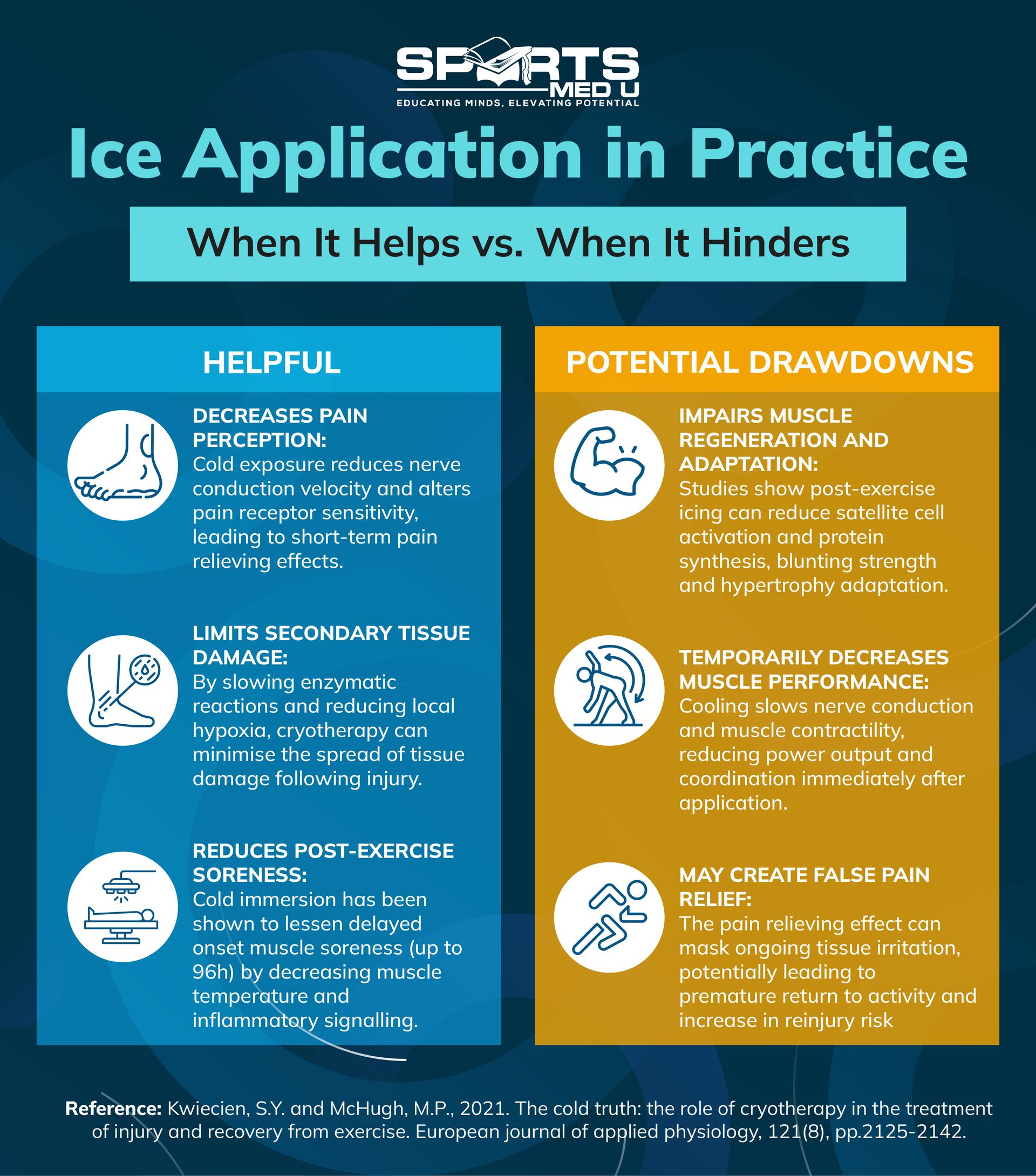
a) Cold application instantly can assist in faster recovery
b) Cold exposure is not recommended after exercise if your goal is to increase performance
c) Use cold exposure to reduce soreness post-exercise if the goal is to recover and not increase muscular performance
Professional takeaway =
Aim to ice acute injury ASAP
Aim of the study
This review will help explain and sum up the latest evidence about how cryotherapies can help with treating injuries and recovering after exercise.
Did you know?
Cryotherapy, a treatment designed to lower body tissue temperature by removing heat, has been used for centuries in the management of injuries.
Injuries can result from a direct insult, such as blunt force trauma, or from mechanical stress that occurs when excessive load is placed on muscle fibers (something that’s particularly common during eccentric contractions)
Prolonged or intense exercise, like marathon running, can also cause what’s known as metabolic stress. In these cases, the initial damage often comes from metabolic disruptions that make muscle fibers more susceptible to mechanical stress.
Heat produced the body..
During exercise, an increase in muscle temperature can indirectly contribute to structural damage. This happens because the elevated temperature raises the metabolic rate and alters the cellular environment, making muscle fibers more vulnerable.
Fortunately, muscle fibers have a natural ability to recover and return to their pre-exercise state, although the speed and extent of recovery depend on the level of activity and the amount of metabolic stress the muscle experiences.
Cryotherapy is often used to help minimise this initial damage, particularly during the secondary phase of the cellular response to injury.
Traditional ICE (Ice, Compression, Elevation) therapy and its variations have long been staples of injury management.
Despite this long history, scientific evidence supporting the effectiveness of the ICE protocol is still pretty limited.
More recently, some literature has started to question the practice of icing altogether, arguing that allowing the body’s natural healing processes to occur without interruption may be more beneficial.
Today, cryotherapy takes many forms—ranging from traditional ice packs to more advanced techniques like whole-body cryotherapy, cold-water immersion, and phase change materials.
These methods are now commonly found in athletic training centers, spas, and even homes.
However, while research continues to look into the molecular effects of cryotherapy, there aren’t consistent, universally accepted protocols.
The Effects of Cryotherapy on Metabolism and Inflammation
Cryotherapy has long been believed to reduce metabolism and inflammation after acute structural trauma by lowering tissue temperature and restricting blood flow to the injured area.
The logic behind this is that a reduction in temperature slows metabolic demand and limits inflammation, helping to control secondary damage.
However, much of the scientific foundation supporting this theory originates from animal studies rather than human trials…
This is challenging to interpret & relate to humans because rodent muscles differ significantly from human skeletal muscles in both metabolism and environmental responsiveness.
Although cryotherapy has been widely adopted in rehab settings, based on these animal findings, there is still no clear evidence that it effectively lowers muscle metabolism in humans.
In other words, while the treatment makes intuitive sense and feels beneficial, the actual metabolic outcomes remain scientifically unproven.
The Effects of Cryotherapy on Tissue Temperature
The traditional understanding of cryotherapy’s effects comes from its ability to trigger a vascular response—specifically, constricting blood vessels to reduce blood flow and thereby decrease metabolism —> inflammation —> tissue damage.
That said, more recent research suggests that cryotherapy’s benefits may depend more on its ability to lower muscle temperature than on its effects on circulation.
Musculoskeletal injuries themselves usually cause localised structural damage rather than systemic increases in body temperature.
As a result, cryotherapy methods that can induce systemic changes (such as whole-body cooling) tend to be more effective for recovery following high-thermal-load exercise. For less thermally demanding activities, local applications like ice packs may be sufficient, as they primarily cool the affected tissues.
On another note,
A commonly overlooked factor is how temperature changes vary across tissue layers.
Skin, fat, and superficial muscle cool more quickly than deeper muscle tissue, and this discrepancy can significantly influence recovery.
Because muscles lack direct thermal receptors, it’s the skin that triggers thermoregulatory responses. Deep muscle tissue primarily loses heat to the superficial layers during cooling.
So, while gel packs can cool the skin rapidly, they don’t always reach deep muscles effectively. Reducing only skin temperature may not meaningfully change muscle metabolism or inflammation.

Injury and Exercise Recovery
Cryotherapy—most commonly in the form of ice packs—is frequently used for strains, sprains, contusions, fractures, and post-surgical or acute MSK injuries.
The idea is that applying ice immediately after an injury slows nerve conduction, providing quick pain relief.
When used soon after injury, it may also help by reducing bleeding and minimising secondary cell damage. However, controlled human studies have not consistently shown that cryotherapy speeds up recovery after musculoskeletal injury.
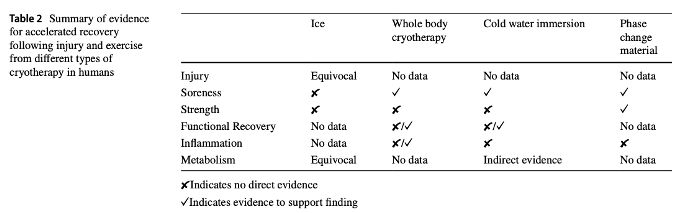
A recent meta-analysis found that using ice as locally does not significantly reduce soreness or enhance strength recovery following exercise.
Nonetheless, other forms of cryotherapy have gained traction in sports recovery settings. Whole-body cryotherapy (brief exposure to extremely cold air ranging from −110 °C to −140 °C) has become increasingly popular among athletes after intense training or competition.
Extensive reviews of whole-body cryotherapy have examined its physiological, neuromuscular, and psychological effects.
And while it doesn’t appear to directly accelerate tissue repair, it does seem to improve the perception of recovery and reduce feelings of soreness after exercise.
Cold-water immersion, another widely used technique, has shown modest benefits in reducing soreness for up to 96 hours after exercise and may help lower blood markers of muscle damage.
Still, differences in outcomes across studies often come down to variations in the temperature and duration of the immersion protocols.
Evidence for Potential Detrimental Effects of Cryotherapy
Inflammation after injury or intense exercise has a dual role
It can contribute to secondary tissue damage
It also essential for healing and restoring normal function.
There is some evidence that regular use of cryotherapy, particularly cold-water immersion, can negatively impact long-term muscle adaptations.
Repeated post-exercise cryotherapy sessions have been linked to reductions in muscle mass, strength gains, and protein synthesis rates. These effects are thought to result from cryotherapy’s suppression of intramuscular temperature, which interferes with the anabolic signaling pathways triggered by glutamine.
That said, using cryotherapy for short, acute periods does not appear to disrupt the body’s natural adaptive mechanisms.
After an initial bout of eccentric exercise, there is little change in inflammation markers, but a second bout typically produces higher levels of proinflammatory cytokines and greater macrophage and T-cell activity.
Repeated cold exposure may blunt these responses and slow recovery from resistance training. However, a single cooling session after one exercise session does not appear to hinder adaptation or protection against future muscle damage.
In Short..
Overall, traditional cryotherapy methods are effective for reducing pain after soft tissue injury and for temporarily easing soreness following strenuous exercise.
The main goal of cryotherapy should be to maintain lower intramuscular temperatures during the immediate recovery period to help limit secondary damage.
Clinical Tips
Athletes should primarily consider cryotherapy during the regular season when anabolic training adaptations are not the focus. Instead, the aim is to facilitate recovery and prevent muscle breakdown following strenuous training/games.
In scenarios with multiple games close together or an evening game followed by a morning practice, expediting recovery takes precedence over muscle adaptation.
Protocols
Immediate Application: Apply cryotherapy as soon as possible after injury or exercise to reduce inflammation and manage pain effectively.
Time of application: It seems like 15-25 minutes of cold exposure 2/3x a day post-injury may have beneficial results in terms of pain levels and potential recovery time
Full body Cold immersion straight after Exercise: This is not recommended as it will blunt the hormonal and cellular responses to mechanical load. Unless the athlete has competition close by and the goal is to feel as fresh as possible
Cold immersion for reducing muscle soreness: Recommended for in-season athletes when preparing for a competition/match which is 24/72 hours away as it will help with soreness, but is not recommended if seeking to improve performance as mentioned above.
3 Resources to Check Out
And learn more about cold exposure
Ice or Heat for pain and injuries (article) - LINK
Rice, PRCE, PILICE (Lecture)
Meme of The Week

When You’re Ready to Learn More
We have great resources for you to devourer
Killer Articles —> Literally everything you need to know about a specific injury
Tendinopathy 4 phase rehab frame work - My book that walks you through a step by step process of treating tendons
Tendininopathy Specific Guides - Learn how to diagnose, manage & treat patellar, achilees and shoulder tendinopathies

Reply